


By Joe Garcia
Johnny Morales struggled to find sleep. He dozed off for a few moments, but officers came to his death row cell and woke him a little after midnight. They needed to inventory and box up his belongings. He was leaving San Quentin.
Hands cuffed behind his back, he walked across the empty upper yard in the dim gray hours before daylight. An officer walked alongside him step for step, black latex-gloved fingers holding onto Morales’s arm.
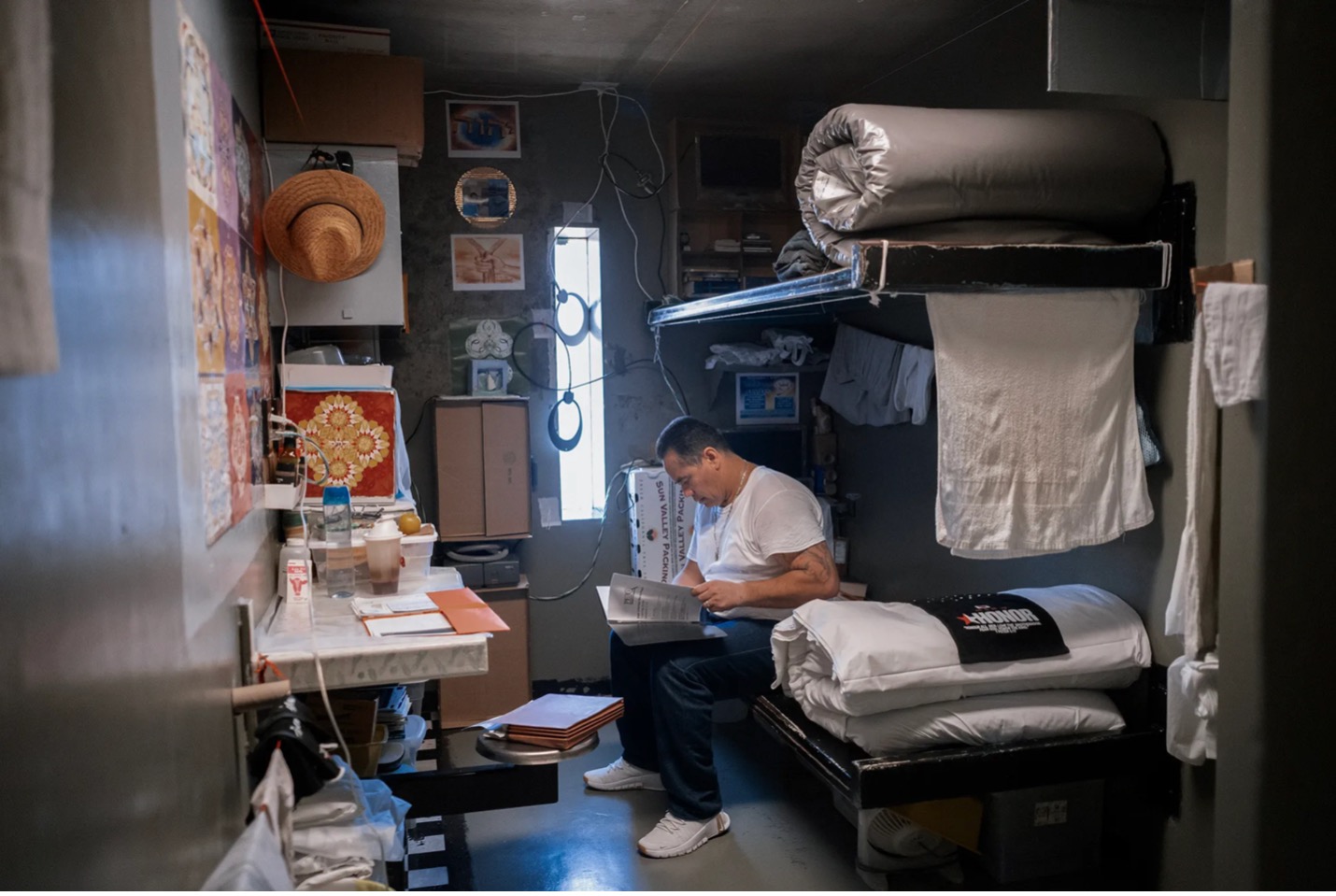
For almost 20 years, Morales could only experience the world outside his 4-by-11-foot cell in the condemned housing unit like this — chained and escorted by officers. Security protocols required all death row residents be handcuffed or shackled any time they were out in open space with staff.
Other prisoners, unshackled and living under a lower security level, would be ordered to halt and turn their backs to the condemned — no eye contact or acknowledgement allowed.
But this caged and severely isolated existence was about to change.
Morales and hundreds of death row residents were gradually being transferred from San Quentin to facilities where they could be treated like any other prisoner. They’d have the opportunity to be part of a general population — to feel an unexpected sense of freedom while remaining incarcerated.
Still sentenced to death, they might never become eligible for parole or release. But improving conditions for them points to bigger questions about incarceration: Do we want our prison environments to focus on rehabilitation and hope? Or should they cultivate harsh punitive conditions? What’s best, in the long run, for public safety outcomes?
“A lot of people are less than sympathetic for this particular cohort — for obvious reasons,” said Dave Lewis, retired facilities director for the California Department of Corrections and Rehabilitation. “But at the same time, we have a responsibility to them to provide an atmosphere that is healthy for their mental health. And I think creating opportunities for self-improvement and programming really goes a long way to doing that.”
The change followed one of Gov. Gavin Newsom’s signature criminal justice policies. In 2019 — just three years after Californians passed an initiative meant to speed up executions — Newsom handed down an executive order suspending the death penalty. It led to the dismantling of the death chamber at San Quentin and the dissolution of the condemned housing unit there.
Because of his near-perfect record of conduct, Morales merited being rehoused at the lowest security level permissible for someone without any current chance at parole. California State Prison-Sacramento just converted a section of its housing to this lower security level and would become his next destination, his new home.
Commonly referred to as New Folsom, the Sacramento-area prison was constructed in the mid-1980s and traditionally stands for hardcore incarceration at the highest level.
When Morales arrived at New Folsom two years ago, officers placed him in a tight holding cage. He shifted his weight back and forth against the cold hard metal. And waited. Officers from his new housing yard had been called to come get him. Hours passed.
“I remember I spent from 11:30 a.m. till 6 p.m. in the small cage where there’s no room, not even to bend,” said Morales. “You just stand still in that little cage. Six hours.
“The moment of truth came when they removed us from those cages. They remove the cuff from everybody, and that’s when, the first time I — no cuff anymore. That was weird right there. But it feel good, too.”
His initial impression of New Folsom was not a pretty one. With so many large geese enjoying the vacant yard areas, their droppings seemed to cover every surface — small pile after small pile. Morales was not sure what he was seeing or stepping around.
For his first stop, officers directed him to the laundry distribution room to pick up his allotment of state-issued clothing and bed linens. Morales stayed hyper-attuned to his own body movement in that small, enclosed space. He’d never been uncuffed around officers before — not without any physical barriers between them for safety.
“I was just trying to remain calm and not do nothing that might make them think I’m gonna do something,” he said. “That’s how my brain was functioning in that moment.
“I want them to know I am not a violent person.”
How he ended up on death row
Morales has viewed his incarceration as a strange and foreign new world since the very beginning. He came to the states from Honduras when he was 17. Johnny Morales is not even his real name — that’s Mario. Johnny is a name he used to find legal work, and it was the only name under state record at the time of his arrest.
On June 9, 2001, he joined a six-man crew who targeted, shook down and robbed drug dealers. One of them said they knew of a meth lab that seemed like an easy score. Morales volunteered to drive. But when they got to the supposed address, they weren’t sure where the lab was located. They split into two groups to enter two different buildings.
It was not long before Morales heard a gunshot from the other building, and soon his associates came running out in a panic. One of them said they’d just shot a woman, Elia Torres Lopez, in front of her young children. They all feared she’d been killed.
As Morales drove the crew away from the scene of the crime, he recognized her name. They’d socialized and danced together several times at a club they frequented. He found out the next day that Lopez had died.
“The moment I agreed to go with these people, I agreed to be a part of whatever happened,” said Morales. “I have to be responsible.”
Morales said he knew almost no English when he entered San Bernardino County Jail a month after the shooting to face murder charges. The courts system and the nonempathetic sheriff deputies who ran the jail made him realize he needed to learn the language for himself, and fast.
He was the only member of the crew arrested for the crime. Prosecutors threatened to pursue the death penalty when he refused to take a plea deal or finger his associates. Because the killing occurred during the commission of a robbery, a 2005 jury found Morales guilty of first-degree murder with special circumstances.
The same jury sentenced him to death in a separate penalty phase trial. He left county jail within days for San Quentin.
By then, reading and education had become more than just keys to survival for Morales. They sparked a passion for learning and fueled a drive for self-improvement. As his English comprehension grew, he read book after book to help free his mind. He turned to his Bible often for hope and solace.
But on death row, the mentality stayed grim. Who might die or be executed next? Those were usually the only ways a condemned person could ever leave the isolated community.
“Our reality was, back then, that like 90% of the people that you know there in San Quentin were gonna die there with you,” he said.
Last gasps inside the death chamber
Morales was living on death row during California’s last two executions, Tookie Williams in 2005 and Clarence Ray Allen in 2006. He never got a chance to interact with them, but he remembers each of their last days alive.
“The officers, the inmates — everybody know what’s about to happen,” said Morales. “You know someone’s coming to kill your neighbor tonight, but there’s nothing in your power to help your neighbor. And it’s not just that night. It’s the whole week, before and after. Everyone feels that tension.”
California has long been conflicted when it comes to the death penalty. In 1972, the state supreme court ruled that executing a person was cruel or unusual punishment. Charles Manson and his crime family had just been sentenced to death for their public murder spree, but they were all spared and given life sentences instead. Legislators responded soon after in 1973 by passing laws to restore the death penalty for certain crimes.
The issue would go back and forth through state legislation and U.S Supreme Court rulings, until California voters chose to codify the death penalty into law in 1978. Still, safeguards to protect convicted persons’ rights have ensured that it could take decades to go from sentencing to execution.
But while executions rarely happened, Morales points out that suicides were a common part of his death row experience. He estimates about 40 self-inflicted deaths occurred in the condemned unit while he lived there from 2005 to 2024.
“There were a lot of people killing themselves — more than actually the state killing them,” he said. “It was very hard, because you get to know people. We’re going through the same thing. To me, it was like when somebody in your family died.
“And in prison, you kill yourself tonight and next day the program continues — like nothing happened.”
Life in cages and chains
Outside his death row cell, Morales could only interact without shackles or handcuffs during recreational yard times, when 20 to 40 condemned prisoners might be let loose together, one by one, in small segregated outdoor spaces. They each also had the option for “walk alone” yard, where they’d be allowed outside in much smaller, single-person enclosures.
Showers, religious services, visits and other activities were always conducted in some form of cage.
In the extreme isolation of Death Row, Morales continued to study books and broaden his world view. That led to a resurgence of his religious faith. Raised in a Catholic family, he found new meaning when he studied and converted to Judaism.
“I really talked to God about my situation, and I feel release,” he said. “I feel that’s my fate — that He’s in charge of everything. I don’t need to be worried.”
The worst of times may have been 2020 — when the COVID-19 virus ravaged the condemned housing unit before rapidly spreading throughout San Quentin. Morales said he was one of the first people on death row to test positive. He fought off the infection and recovered while knowing others around him were dying.
“That really hit me hard,” he said. “It doesn’t matter who. Everybody got hope to one day go home. That’s the last thing you lose in this kind of place. Their hope died when they died.”
San Quentin’s Rabbi Paul introduced Morales to Matir Asurim, a Jewish care network for incarcerated persons. The name comes from a Hebrew verse that invokes blessings to free those bound in physical captivity — but also to liberate them spiritually.
And through the organization’s support network, Morales met Liz Silver. They were paired together as pen pals in 2022 and introduced themselves through correspondence. The connection blossomed quickly to include regular phone calls and face-to-face visits.
“It was very positive for me,” said Silver. “There was an integrity about him. How did this person — in this little teeny size of a cell, you know — have the hope and the drive? I saw that about him, and I admired it.”
Morales and Silver talk almost every single day. They each refer to the other as their closest friend.
“Elizabeth is a truly beautiful person,” said Morales. “I have faith in my God that he put the right people in my life when I need them to be. And she is one of those right people.”
He also credits San Quentin’s mental health system with helping him navigate the bleak environment of the condemned housing unit. Therapists and clinicians would walk the different tiers of East Block to check on the death row residents and offer counseling.
“You don’t have to be crazy to go there,” said Morales. “You just go, talk to them and explain your situation. I’ve never been afraid of asking for help. If you can get help, why not?”
Better vibes and opportunities
Newsom visited San Quentin in 2024 before the condemned prisoners were all moved out, and he made sure to spend time inside East Block. Morales got a chance to speak to him.
“It was very emotional, to see him walking there — like honoring us, acknowledging us,” said Morales. “In my heart, I was filled with gratitude. Not just for that moment, but for everything he’s done for us.
“We were literally dying there in East Block by ourselves. That life right there is not life. We had no program, no anything. It was bad.”
But on the recently converted lower security yard in New Folsom, Morales can now follow his own interests without the physical and mental restrictions he endured for so many years. He can move about from his cell to other areas and interact with peers more naturally.
The lower security environment is also what the system refers to as “non-designated,” which means all categories of prisoners are, for the most part, accepted there — openly LGBTQ people, gang culture dropouts, sex offenders and various other stigmatized individuals. At other prison levels and yards, incarcerated communities will be far less accepting and usually react violently to remove them.
Non-designated facilities generally focus on providing more educational and rehabilitative opportunities. Violent problematic prisoners ultimately push themselves to the higher security levels and harsher environments, while positively programming individuals strive to get along.
Morales fit in immediately and felt more at ease in the peaceful laidback setting. Four days after he got to New Folsom, they assigned him a cellmate. The cells are bigger than at San Quentin, but it’s the first time he’s ever had to share living space with another prisoner.
“Everything is a challenge,” he said. “To me, it’s more opportunity to reconnect with what I call ‘being normal.’ Being away from society, away from people — it deprives you from all of that.
“It’s a great opportunity to put into work all those areas that I’ve not been using for many years. When you live in the cell by yourself, who do you complain to? I’m learning to communicate.”
The freedom to mingle like a normal prisoner means Morales can now encourage and help others find a positive path. From the start in New Folsom, he used his bilingual skills to tutor the Spanish-speaking community on his own whenever he could, remembering how difficult it was for him to navigate jail and prison without knowing English.
The education department noticed and quickly assigned Morales a job as a clerk and teaching aide. When the Peer Literacy Mentorship Program came to his yard, he applied and was chosen to participate. The program formally trains and certifies guys like him to teach GED coursework to his incarcerated peers.
“This prison right here have a large Spanish-speaking community — a lot of Mexicanos and Hispanics,” he said. “I love it. As a tutor, I do a lot of stuff. It makes me feel like normal. I call it ‘normal’ because I’m like anybody else. No difference.”
Morales stays busy, busy, busy. He just started his first community college class, English 101. College enrollment includes an assigned laptop to do his coursework and submit his work via WiFi. His world right now continues to evolve.
“I’m still a rookie in all this, still a baby,” said Morales. “I really wanna rehabilitate myself. I wanna do it the right way. I always felt before like I was a good person because I stayed away from drugs, from alcohol — things that violate the rules in prison. I was never involved in fights or contraband.
“But it wasn’t until I got here that I learned that considering myself a good person does not necessarily mean I’ve been rehabilitated, not in a proper way.”
A lot of his newfound rehabilitative growth stems from conversations with peers who have life sentences and have been working on their own personal change for a long time. Morales might be the mentor or the mentee. They all try to learn from each other’s experiences.
Silver lives in Marin County and makes the drive up to New Folsom on weekends to visit Morales. She continues to see and appreciate her friend’s ongoing transformation.
“He is so remorseful about his crime and that a mother was taken away from her children,” said Silver. “He feels so much remorse. He’s accepted everything. Sometimes I feel like he’s accepted it too much. He talks about it a lot.”
Morales speaks openly about his past, about the consequences of his actions and about the level of inner peace he’s found over the years. Sharing his story brings a lot of the trauma back up to the surface for him — his own trauma, and the trauma he caused on others. But he believes that’s part of his rehabilitative healing.
“It’s hard to process, but when I think about all the harm and damage, I’m just blessed to be alive,” he said. “We never gave the victim the opportunities that I have now.”
