


By Deborah Brennan
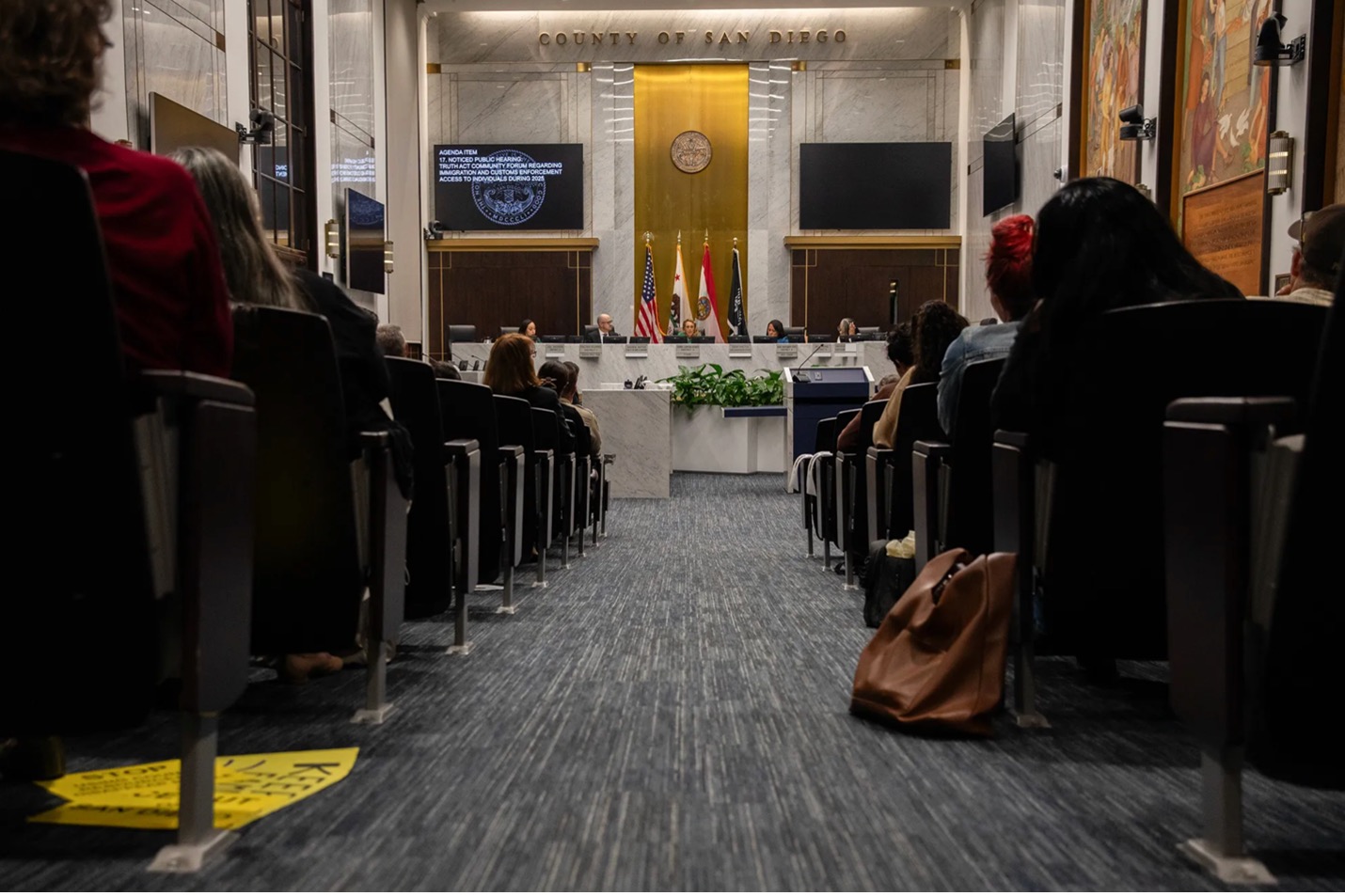
San Diego County banned federal immigration agencies from using county firearms training facilities, in a split decision that pitted public outrage over ICE raids against concern that cutting access to the firing range could divert officers from the border.
Three Democratic supervisors argued that local firing ranges should not be “a training ground for President Trump’s mass deportation agenda.”
“I think the very core bottom line is that we’ve seen too many people dying at the hands of armed ICE agents, and I do not believe that we at the county should be complicit,” Board Chair Terra Lawson-Remer said.
She and Chair Pro Tem Paloma Aguirre called for ending the agreement with the U.S. Immigration and Customs Enforcement and Customs and Border Protection, arguing that aggressive immigration raids separate families and generate fear.
“The federal government cannot terrorize our families all week and rent our firing range on the weekend: not on this county, not anymore,” Aguirre said.
Their two Republican colleagues voted against the cancellation, calling for improved cooperation between immigration officers and local law enforcement, and warning that cutting access to firearms training could disrupt border operations and increase wait times at border crossings.
“I’ll admit, ICE has overreached and overstepped,” said Supervisor Jim Desmond, one of two Republicans on the board. “But how do you fix that? You fix it with more training.”
Sydney Aki, director of field operations for Customs and Border Protection in San Diego, said his office assists with crossings for 225,000 people per day, along with 90,000 passengers and 5,500 trucks carrying $174 million in merchandise. He argued that interagency cooperation is important for that task.
“We can talk to one another, de-escalate situations, all those things coming to play when we work together,” he said.
CBP Commissioner Rodney Scott warned that the loss of training opportunities for agents would lead to longer lines at San Ysidro, Otay Mesa and Tecate border crossings and at the San Diego International Airport and seaport.
“The San Diego County Board of Supervisors’ reckless, irresponsible, and ignorant proposal to limit the preparedness of frontline CBP personnel endangers lives and will cause immediate economic harm,” he wrote in a statement. “International ports of entry are economic engines. The San Diego County Board of Supervisors is poised to slam on the brakes at all San Diego County ports for political reasons.”
Aguirre disavowed that warning, saying the relatively small contract would have a minimal impact on the agency’s operations. “Lines at San Ysidro would not be a consequence of this board’s actions,” she said. “They would be a choice made by the Trump Administration and paid for by us here in San Diego.”
The San Diego decision contrasts with a similar debate in Escondido in February, when the city council upheld its contract with the Department of Homeland Security to use the city firing range for immigration enforcement training, despite public condemnation of the agreement.
Aguirre noted that the Escondido range and other facilities throughout the county remain open to immigration agencies, so officers would not have to leave the region for firearm drills.
“I will mention that CBP and ICE have extensive alternative options,” for training, she said.
A series of high-profile raids and arrests in San Diego have fueled unease with aggressive immigration enforcement. In May 2025, ICE agents stormed Buona Forchetta restaurant in San Diego, arresting four people and sparking a public outcry. In August last year they detained parents outside schools in Encinitas, Chula Vista and San Diego.
Alondra Alvarez, a community educator with Universidad Popular, a nonprofit in North County San Diego, said aggressive immigration actions sow distrust in government.
“If the county is serious about saying that immigrant families should not fear their local government, then county-owned and county-leased property cannot be used to train the federal immigration agencies driving that fear,” she told the board of supervisors.
A CalMatters investigation of government data found that immigration arrests surged by 1,500% for May to October compared to the same time period a year earlier.
Immigration authorities removed more than 16,000 people from San Diego County between January 20, 2025, and April 1, 2026, according to figures released by Rep. Mike Levin, a Democrat who represents parts of San Diego and Orange Counties.
Although federal officials have stated that they target immigrants with records of serious crime, Levin said ICE did not disclose how many of the San Diego detainees had criminal convictions.
Those aggressive raids could compromise public safety by deterring some people from reporting crimes or seeking help from law enforcement, supervisors said.
“Providing training grounds for Trump’s deportation force is a slap in the face of our residents and undermines our clear commitment to rule of law and civil rights here in San Diego County,” Lawson-Remer said.
Since 2024, federal immigration agents have logged about 3,350 hours at the San Diego Regional Firearms Training Center in Otay Mesa near the border, according to the county.
The agreements allowing immigration agents to use county firearms facilities were signed in 2021 and generate an estimated $126,780 in revenue, the board letter states. Those contracts were small enough that they were approved by administrators, without a vote by the board of supervisors.
The board decision last week ends the contract, as well as use of a separate firing range that the county leases from the U.S. Navy on Marine Corps Air Station Miramar, supervisors said.
It’s the latest effort by supervisors to limit county coordination with federal immigration authorities. In January, San Diego County passed the Civil Liberties Enforcement and Accountability Rules ordinance, or CLEAR ordinance, to restrict federal immigration agents from accessing non-public county spaces. That law passed with support from Lawson-Remer, Aguirre, and fellow Democrat, Supervisor Monica Montgomery Steppe. The two Republican board members, Jim Desmond and Joel Anderson, opposed it.
In June, San Diego County won a lawsuit against the Department of Homeland Security, allowing for health inspections of the Otay Mesa Detention Center, after Lawson-Remer, Aguirre and San Diego County Public Health Officer Sayone Thihalolipavan were denied access to the facility months earlier.
“I think the majority of this body has made it very clear through policy that its intent is for the county of San Diego to cease cooperation and partnership with Federal immigration enforcement agents,” San Diego County Vice Chair Monica Montgomery Steppe said.
